


CureHeart researchers map the cells of the HCM heart in unprecedented detail using AI
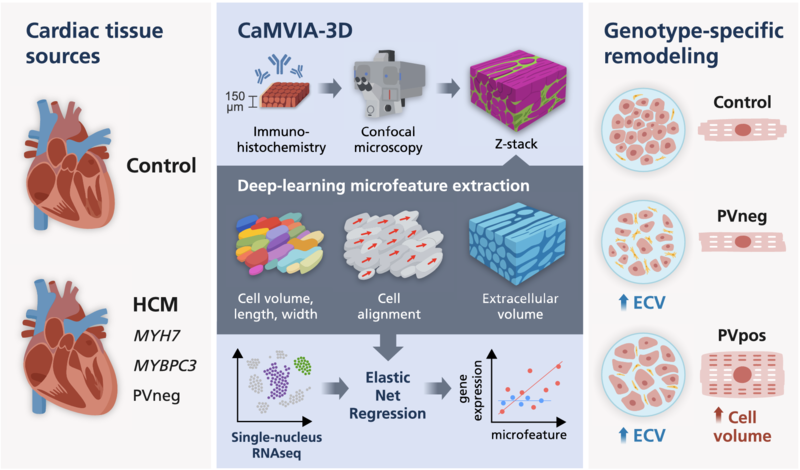
This week saw the publication of a ground breaking new study from CureHeart researchers Eric Wei and Martin Beyer. Working with CureHeart PIs, Jon and Christine Seidman the publication in Science, uses AI deep learning and high resolution laser scanning microscopy to reconstruct detailed 3D images of heart tissue.
The algorithm - CaMVIA-3D can forensically dissect the heart blocks of the heart muscle to look at how the individual cells can alter in size, shape and alignment as hypertrophic cardiomyopathy (HCM) progression changes the overall size and shape of the heart. The technology can also measure precisely how fibrotic scaring (a common hallmark of HCM) can develop before any other changes. The study goes on to look at the fundamental differences between familial and non-familial HCM, where it finds that most changes to heart function are a result of scaring rather than cell shape when there is no clear genetic cause. Finally the study linked all of these changes to gene expression in individual nuclei of the remodelled cells.
Mapping these processes and relating it back to the size and shape of the tissue will allow CureHeart and other translational research teams to personalise treatment more comprehensively in the future, by designing bespoke treatments depending on disease progression and cause.

